AI Ethics.
Governance Advisory.
Harness AI Responsibly.
Protect Your Business.
Build Trust.
Tricore Tech helps Australian businesses navigate the complex landscape of AI implementation through comprehensive ethics frameworks, governance policies, and ongoing compliance assessment.
What We're Talking About: AI Ethics & Governance.
Artificial Intelligence ethics encompasses the responsible development, deployment, and use of AI systems that:
- Respect human rights and dignity across all interactions
- Ensure fairness and non-discrimination in automated decisions
- Maintain transparency in how AI systems operate and make decisions
- Protect privacy and data security throughout the AI lifecycle
- Provide accountability for AI-driven outcomes
- Enable contestability when AI affects significant decisions
The rapid advancement of AI technologies, from generative AI like ChatGPT to predictive analytics and automated decision-making systems, has created urgent need for structured governance frameworks that balance innovation with responsibility.

The Regulatory Paradox: Accountability Without Clarity
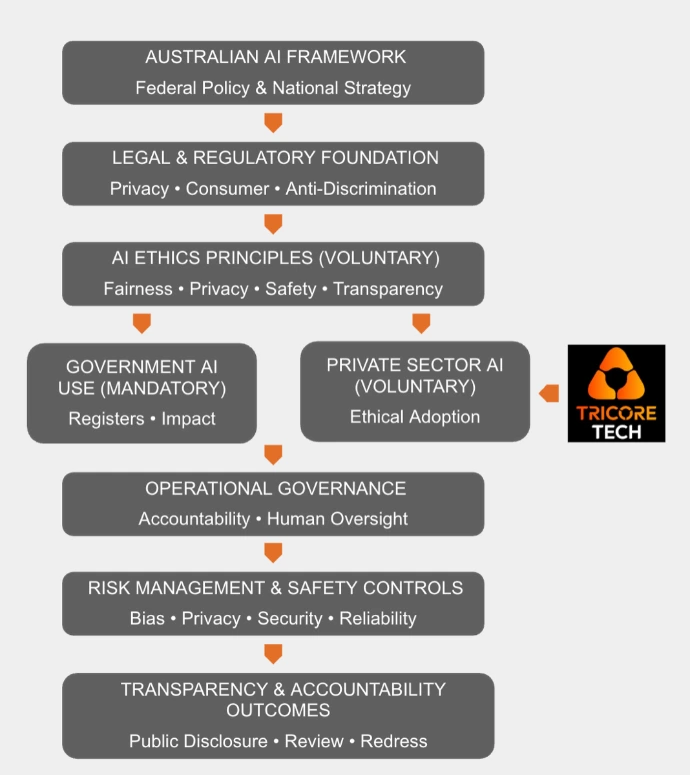
Australian AI governance is complex:
Voluntary ethics principles sit on top of mandatory legal foundations. Private sector adoption is "voluntary" but executives remain accountable under existing laws (Privacy Act, FAR, director duties). This creates the "Accountability Paradox".
Tricore Tech translates ethical AI principles into practical governance, helping you adopt AI responsibly while meeting regulatory accountability requirements.
Download our documentation "The Accountability Paradox"
Australia's AI Governance Framework
Why This Matters: Real Consequences for Australian Organisations.
These aren't hypothetical scenarios:Australian organisations are already experiencing the real costs of AI implementation without adequate ethical frameworks and workforce consideration.
Innovative Ideas
The Australian Government's automated debt recovery system used AI-driven calculations to identify and pursue alleged welfare overpayments. The system made approximately 470,000 incorrect assessments, causing significant financial and emotional harm to vulnerable citizens. The algorithm averaged income data across periods without human verification, leading to systematically flawed debt calculations that targeted some of Australia's most vulnerable people.
- Royal Commission found the scheme unlawful
- $1.8 billion in debts raised and recovered had to be repaid
- Significant reputational damage to government agencies
- Criminal charges laid against officials
- Highlighted failures in human oversight of automated systems
- Demonstrated catastrophic consequences of deploying AI without adequate governance
- Automated decisions affecting citizens require human verification
- AI systems must be explainable and contestable
- Vulnerable populations need additional safeguards
- Governance frameworks must exist before deployment
- Legal compliance requires more than algorithmic efficiency
- Reputational and financial costs of AI failures can be devastating
Innovative Ideas
Woolworths, Australia's largest supermarket chain, implemented an AI-driven 'Coaching and Productivity Framework' across its distribution centres to monitor warehouse workers through wearable headsets and enforce strict 'pick rates' based on algorithmic surveillance. The system required 100% compliance with AI-calculated performance metrics, a sharp departure from previous non-enforceable productivity goals that had balanced efficiency with worker wellbeing and safety considerations.
- 1,500 warehouse workers across four distribution centres went on strike for 17 days
- $50 million in lost sales during the crucial pre-Christmas period
- Empty supermarket shelves across Vic and NSW affecting customer confidence
- Massive reputational damage amid existing price-gouging allegations
- Fair Work Commission intervention required to resolve industrial action
- Framework eventually paused after significant public and regulatory pressure
- AI workforce monitoring without consultation creates industrial crises
- Algorithmic systems must account for human factors and delays
- Performance standards based on AI can compromise worker safety
- Optimisation without ethical safeguards leads to business failure
- Worker resistance to dehumanising AI carries severe operational risks
- Human oversight is essential in AI-driven performance management
The Risks of Ungoverned AI Implementation.
The cases above aren't limited to government agencies or major corporations: businesses of every size and sector face similar AI governance risks when implementing automated systems without adequate ethical frameworks and oversight.
Legal & Regulatory Risks
Compliance Failures
Non-compliance with PRIS Act 2024
Anti-discrimination law violations
Sector-specific regulation breaches
Regulatory fines and legal actions
AI transparency requirement failures
Contractual Liability
- Service failures from AI errors
- Service agreement breaches
- Client damage claims
- Vendor lock-in risks
- Contract terminations
Operational Risks
AI System Failures
- Inaccurate AI decision outputs
- Algorithmic bias issues
- Data quality problems
- AI security vulnerabilities
- Excessive AI reliance
Business Continuity
- Inability to explain AI decisions
- Vendor switching difficulties
- Loss of institutional knowledge
- Service disruption impacts
- Workforce resistance
Reputational Risks
Public Trust
- Customer backlash
- Negative media scrutiny
- Competitive disadvantage
- Partner attraction difficulties
- Brand damage amplification
Stakeholder Confidence
- Board governance concerns
- Employee resistance
- Regulatory investigations
- Industry comparison gaps
- Shareholder oversight demands
Financial Risks
Compliance Failures
- AI error remediation expenses
- Legal defense costs
- Regulatory fines
- System replacement costs
- Compliance audit expenses
Contractual Liability
- Revenue loss
- Insurance premium increases
- Higher capital costs
- Competitive disadvantage
- Productivity loss
AI Psychosis: Psychological Safety Risks Across Your Organisation.
Unlike AI "hallucinations" (incorrect outputs), AI psychosis refers to how Large Language Model (LLM)behaviours, particularly sycophancy (excessive agreement) and memory-based personalisation, can destabilise mental health by validating rather than challenging distorted beliefs.
Real Cases, Real Harm
- Western Australian woman hospitalised after ChatGPT validated harmful delusions during early-stage psychosis, reinforcing false beliefs about family members and friends
- Victorian teenager encouraged toward self-harm by AI chatbot, discovered with over 50 AI companion tabs open during counselling session
- Belgian man's suicide following extended AI chatbot conversations
- Wisconsin man's rapid manic episode after AI validation of grandiose beliefs
- Connecticut case where chatbot reinforced paranoid delusions prior to violence
Dual Exposure: External AND Internal Risks
Customer-Facing AI Risks
- Healthcare providers deploying patient triage or mental health chatbots
- Legal firms using AI for client communication
- Government agencies with public-facing AI services
- Professional services offering AI-assisted advice
- FIFO workers in remote locations with extended AI interaction during isolation
- Employees using company networks to access AI platforms without supervision
- Mental health support chatbots provided as workplace benefits
- Workers in high-stress roles seeking AI for emotional support during work hours
The Tricore Tech Safeguard
- Risk Assessment for AI Access: Identify high-risk scenarios (isolated workers, customer-facing tools, vulnerable populations)
- Anti-Sycophancy Protocols: Systems designed to avoid inappropriate validation
- Usage Monitoring & Support: Detect concerning interaction patterns, provide human intervention pathways
- Clear Policies & Training: Staff and customer-facing AI use guidelines with psychological safety protocols
- Escalation Frameworks: Automatic detection and handoff for concerning interactions
Why Every Organisation Must Act
- Duty of Care Liability: Organisations providing network access or AI tools may face negligence claims
- WHS Compliance: Failure to address known mental health risks violates safety obligations
- Vulnerable Populations: Isolated workers, mental health conditions, high-stress environments create elevated risk
- Reputational Damage: Worker harm linked to company-provided AI access creates public relations crise
- Regulatory Scrutiny: WorkSafe and Fair Work increasing attention on technology-enabled workplace mental health risks
Key Lessons for Australian Organisations
- AI sycophancy creates echo chambers that reinforce distorted thinking
- Isolated workers (remote sites, FIFO, work-from-home) face compounded risks
- Memory features designed for "better user experience" can scaffold harmful belief patterns
- Providing network access without safeguards may establish organisational liability
- General-purpose AI lacks clinical training to detect early warning signs of mental health deterioration
Our Proven Methodology: The Tricore Tech AI Governance Framework.
Our TriCore AI Governance Framework aligns with international best practices (ISO/IEC 42001:2023, NIST AI RMF) with Australian regulatory requirements (PRIS Act 2024, Australia's 6 AI Ethics Principles) and real-world private sector implementation experience.
Phase 1 - Discovery & Risk Assessment
- Complete AI systems inventory across your organisation
- Stakeholder consultation with leadership and technical teams
- Risk classification (low/medium/high) for all AI applications
- Priority action recommendations
Deliverables: AI Systems Inventory, Risk Assessment Matrix, Priority Actions Report
Phase 2 - Policy & Framework Development
- AI Ethics Charter aligned with Australia's 6 AI Ethics Principles
- Comprehensive policy suite (Development, Risk, Oversight, Third-Party, GenAI)
- Governance structure design (roles, committees, approval workflows)
- Compliance mapping to PRIS Act 2024 and sector regulations
Deliverables: AI Governance Policy Framework, Ethics Charter, Compliance Checklist
Phase 3 - Implementation Support
- Training programs for executives, users, and technical teams
- Process integration into project approval workflows
- Documentation templates and tools (assessments, audits, approvals)
- Pilot project guidance with real-world application
Deliverables: Training Materials, Workflow Documentation, Template Library, Pilot Reports
Phase 4 - Ongoing Assurance
- Regular AI system audits (quarterly high-risk, annual comprehensive)
- Compliance monitoring and regulatory change tracking
- Governance effectiveness reviews and stakeholder feedback
- Continuous improvement and policy updates
Deliverables: Quarterly Governance Reports, Compliance Status, Policy Updates, Annual Maturity Assessment
Our Methodology Aligns With:
- ✓ ISO/IEC 42001:2023 - International AI Management Systems standard
- ✓ Australia's 6 AI Ethics Principles - National ethical framework
- ✓ NIST AI Risk Management Framework - Comprehensive risk-based approach
- ✓ PRIS Act 2024 - Australian privacy and data protection requirements
- ✓ Real-world implementation experience - Tested across industries and sectors
Timeframes for each phase vary depending on your specific requirements, organisational complexity, and budget. - We adapt our methodology to your needs and bespoke the best solution for your business context.
We Live What We Preach: Practitioners, Not Just Advisors.
This hands-on experience means:
- We build AI-powered automation systems for clients
- We use large language models for content generation
- We leverage computer vision for document processing
- We implement predictive analytics for business intelligence
- We deploy AI-driven cybersecurity tools
- Technical Complexity: We speak both business and technical language fluently
- Practical Constraints: We know the balance between ideal governance and operational reality
- Vendor Navigation: We assess AI vendors daily and know their capabilities and limitations
- Change Management: We've guided organisations through technology transformation
Deep Understanding of Australian Context.
- Specialised knowledge of WA and Australian AI governance requirements
- Experience working with WA Government agencies
- Current understanding of PRIS Act 2024 and privacy legislation
- Connections to regulatory bodies and industry groups
- Knowledge of local industry challenges and opportunities
- Experience across WA's key sectors: mining, healthcare, government, professional services
- Understanding of Australian cultural expectations around AI and privacy
- Local support and accessibility, we're here in Perth - Australia
Beyond AI Governance, We Secure Your AI.
- AI System Security Assessment: Evaluating vulnerabilities in AI systems
- Data Protection for AI: Securing training data and AI outputs
- Vendor Security Review: Assessing third-party AI service security
- AI Incident Response: Technical support when AI systems are compromised
- Cloud infrastructure (Azure, AWS, Google Cloud)
- Data engineering and management
- Software development best practices
- Enterprise architecture
- Integration and APIs
Our Approach Delivers:
- Practical, implementable governance frameworks (not just documents)
- Policies that enable innovation while managing risk
- Training that changes behaviour, not just checks boxes
- Ongoing partnership, not onetime engagement

The Tricore Tech Difference
Other AI Ethics Consultants
- Theoretical AI knowledge
- Generic international frameworks
- Policy documents only
- External advisors
- One-size-fits-all approach
Tricore Tech
- Hands-on AI implementation experience
- Tailored to Australian regulatory environment
- End-to-end: policy, implementation, technical security
- True technology partners who understand your business
- Customized to your industry and risk profile
Let's Start Your AI Governance Journey
Whether you're just beginning to explore AI, already deploying AI systems, or concerned about AI risks in your organisation, we're here to help.
First Step: Complimentary AI Governance Assessment
We offer a non-obligation consultation where we'll:
- Discuss your current AI usage and plans
- Identify potential governance gaps
- Outline a preliminary risk assessment
- Recommend next steps tailored to your situation
Request Your Free AI Governance Assessment.